Skip to content

What Is the PCT System?
The Patent Cooperation Treaty (PCT) is an international treaty administered by the World Intellectual Property Organisation (WIPO). It provides a unified procedure for filing patent applications to protect inventions in multiple countries. Instead of filing separate national or regional patent applications, applicants can file a single “international” application under the PCT to seek protection in over 150 member countries.
Why the PCT System Matters
In a global innovation ecosystem, inventors and companies often need patent protection across multiple jurisdictions. The PCT system:
- Simplifies the process of applying in many countries
- Delays costs associated with foreign filings
- Provides valuable insights into patentability and commercial prospects
Key Benefits of the PCT System
- Single international application in one language
- Defers national phase entry (and associated costs) by up to 30 or 31 months from the earliest filing date
- International search and preliminary examination provide insight into patentability
- Global reach: Protect your invention in any of the 157+ PCT contracting states
- Centralized formal processing and publication by WIPO
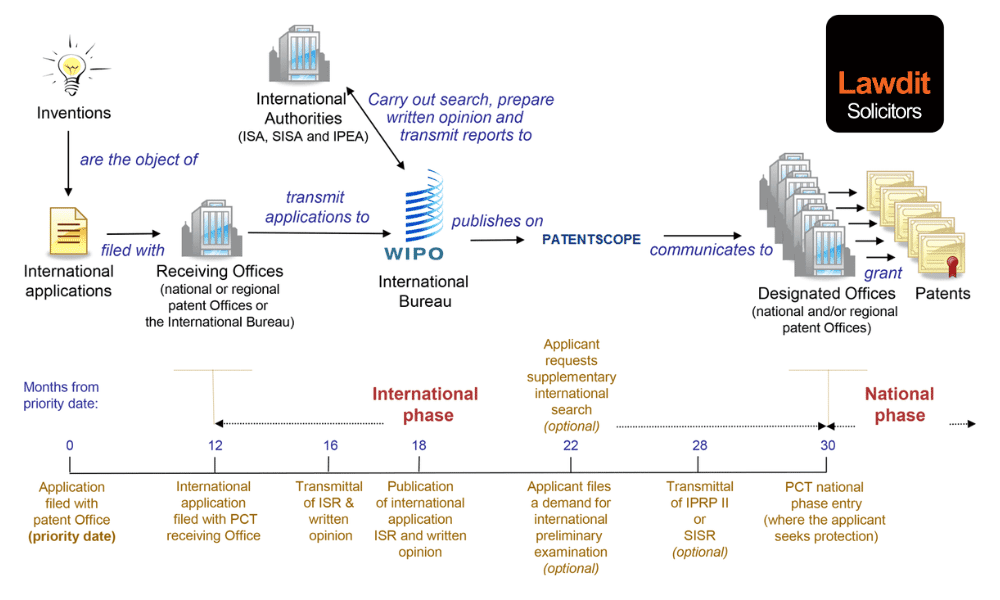
How the PCT System Works: Step-by-Step
1. Filing the International Application
The applicant files an international application with:
- Their national or regional patent office (e.g., UKIPO)
- Or directly with WIPO (in some cases)
This application must be filed within 12 months of the first (priority) filing, typically a national application.
2. International Search
An International Searching Authority (ISA)—such as the EPO, USPTO, or UKIPO—conducts a search to identify prior art and issues:
- An International Search Report (ISR)
- A Written Opinion on the invention’s patentability (novelty, inventive step, and industrial applicability)
This helps the applicant assess whether to pursue protection and in which countries.
Prior art relates to what is already in the public domain. It is essential that any invention has not already been put out into the public domain, otherwise this will prevent the patent application from succeeding, even if the application is for the same product. This process ensures that the invention is new and hasn’t already been created by another party.
3. International Publication
After 18 months from the priority date, WIPO publishes the application and ISR in the PATENTSCOPE database, making it publicly accessible.
4. Optional: International Preliminary Examination
Applicants may request an optional second-phase examination (Chapter II) to receive a more detailed International Preliminary Report on Patentability (IPRP). This helps refine the application before entering national phases.
5. National Phase Entry
By 30 or 31 months from the earliest priority date, the applicant must enter the national phase in each country or region where they want protection. This involves:
- Translating the application (if required)
- Paying national fees
- Meeting local patent requirements
At this point, each national patent office makes its own decision on granting the patent based on local laws.
Important Deadlines
| Stage | Time from Priority Date |
| PCT filing | 12 months |
| International publication | 18 months |
| Optional preliminary examination request | 22 months |
| National phase entry | 30 or 31 months (depending on country) |
Common Misconceptions
- The PCT doesn’t grant an “international patent.” It facilitates filing in multiple countries, but each patent is still granted and enforced nationally.
- The PCT doesn’t replace national laws. Each patent office applies its own rules during national phase examination.
Who Can Use the PCT?
To file under the PCT, at least one applicant must be a national or resident of a PCT Contracting State. The system is open to:
- Individual inventors
- Startups
- Universities
- Multinational corporations
The PCT system is a powerful tool for inventors and companies seeking broad international patent protection. It offers a strategic and cost-effective approach to entering multiple patent markets while providing valuable early insights into the patentability of an invention. Lawditr Solicitors can guide you through the process, ensuring you take the best course of action to provide protection.
If you would like some further information, please get in touch with the team today.